Acres and Satoshis: How Americans Are Pairing Land Ownership With Bitcoin to Build Real Financial Freedom
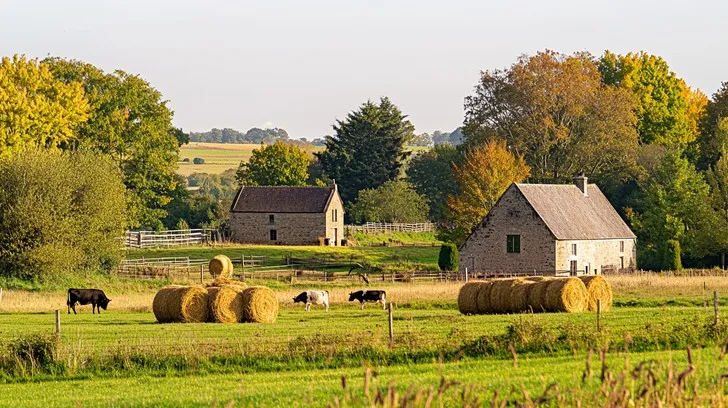
Photo: rural American homestead farmland with laptop and cryptocurrency, via images.stockcake.com
There's something deeply American about the idea of owning a piece of the earth. The notion that a person could work hard, plant their feet on a patch of ground, and call it theirs has been baked into this country's identity since long before the original Homestead Act of 1862 handed out 160-acre parcels to anyone willing to work them. Fast forward to today, and a new generation of Americans is rewriting that story — only now, alongside the deed to their property, they're stacking satoshis.
It sounds like an odd pairing at first. Dirt and digital assets. Fences and cold wallets. But when you dig into the philosophy behind it, the combination makes a surprising amount of sense.
The Old and the New, Side by Side
Land has always been considered one of the most reliable stores of value in human history. It's finite. It's tangible. You can grow food on it, build on it, and pass it down to your kids. Bitcoin, for all its differences, shares some of those same core properties — it's scarce by design, it can't be inflated away, and with the right custody setup, it's yours and nobody else's.
That philosophical overlap isn't lost on the people living it. Take Marcus and Deanna Tillwell, a couple in rural Tennessee who spent years saving to buy a 12-acre property outside of Cookeville. They raise chickens, grow a large vegetable garden, and sell eggs at the local farmers market. They also, quietly, have been accumulating Bitcoin since 2019.
"We think of the land as our foundation and Bitcoin as our fire escape," Deanna says. "The land feeds us and keeps us grounded. The Bitcoin is there in case the dollar gets weird — or in case one of our kids wants a head start someday."
That framing — land as stability, Bitcoin as optionality — comes up again and again among people who've embraced this dual-asset approach.
Why This Isn't Just a Prepper Fantasy
It would be easy to dismiss this crowd as a fringe group of doomsday preppers who want to grow their own food and opt out of society. But that's not really what's happening here. Many of the people combining land and Bitcoin are firmly middle-class Americans who've simply done the math and decided they don't want their entire financial future riding on 401(k) accounts and a housing market they can barely afford to enter.
In fact, some of them are surprisingly sophisticated about it. Jake Moreno, a freelance software developer in New Mexico, bought a half-acre lot outside Albuquerque in 2021 and has been dollar-cost averaging into Bitcoin ever since. He runs a small homestead operation — fruit trees, a greenhouse, a rainwater collection system — while keeping his tech career going remotely.
"I'm not anti-system," Jake says. "I just want multiple systems. If one breaks down, I've got another one running."
That kind of redundancy thinking is central to the appeal. Land can't be hacked. Bitcoin can't be printed. Together, they cover a lot of the scenarios that keep financially anxious Americans up at night.
The Practical Side of Running Two Asset Classes
Of course, it's not all philosophical poetry. Managing land and Bitcoin at the same time comes with real logistical considerations.
On the land side, there are property taxes, maintenance costs, and the time investment of actually working a homestead. On the Bitcoin side, there's the learning curve of self-custody, the volatility that can make short-term planning difficult, and the ongoing question of when — or whether — to sell.
Financial planners are starting to pay attention to this trend, though many remain cautious. "The diversification logic isn't crazy," says one independent advisor based in Colorado who works with several clients holding both real estate and crypto. "Land and Bitcoin are both inflation hedges in their own way. The challenge is liquidity. Land is slow to convert. Bitcoin is fast but volatile. You need to be honest about your time horizon."
That liquidity mismatch is real, but many in this community see it as a feature rather than a bug. The friction of selling land keeps you from panic-selling during a downturn. The portability of Bitcoin means you can access value quickly if you genuinely need it.
Building Wealth That Actually Belongs to You
Perhaps the most compelling thread running through this movement is the concept of ownership — real, unambiguous ownership. Not a share of a fund that holds a derivative of a commodity. Not a mortgage on a house in a neighborhood you can barely afford. Actual land with your name on the deed. Actual Bitcoin in a wallet only you control.
For a lot of Americans, that kind of sovereignty feels increasingly rare. Wages haven't kept up with asset prices. Renting has become the default for millions of younger adults. The traditional path to financial stability — get a job, buy a house, save in a 401(k) — feels less certain than it did for previous generations.
The land-plus-Bitcoin approach isn't a perfect solution, and it's definitely not accessible to everyone. Rural land is cheaper than urban real estate, but it still requires capital. Bitcoin requires patience and financial discipline. Neither asset is without risk.
But for the people who've committed to this path, there's something powerful about building a wealth foundation that doesn't depend on anyone else's decisions. No landlord. No fund manager. No central bank.
Just acres, satoshis, and a long-term plan.
Is This the New American Dream?
The original homesteaders were betting on the future of a country that was still figuring itself out. They took on risk, did hard work, and built something lasting. There's a version of that same spirit alive in the people combining land and Bitcoin today — a willingness to step outside the conventional financial playbook and bet on their own judgment.
Whether this becomes a mainstream movement or stays a niche lifestyle choice remains to be seen. But as more Americans look for alternatives to a financial system that often feels stacked against them, the combination of roots in the ground and keys in a cold wallet is starting to look less eccentric and a whole lot more like common sense.